
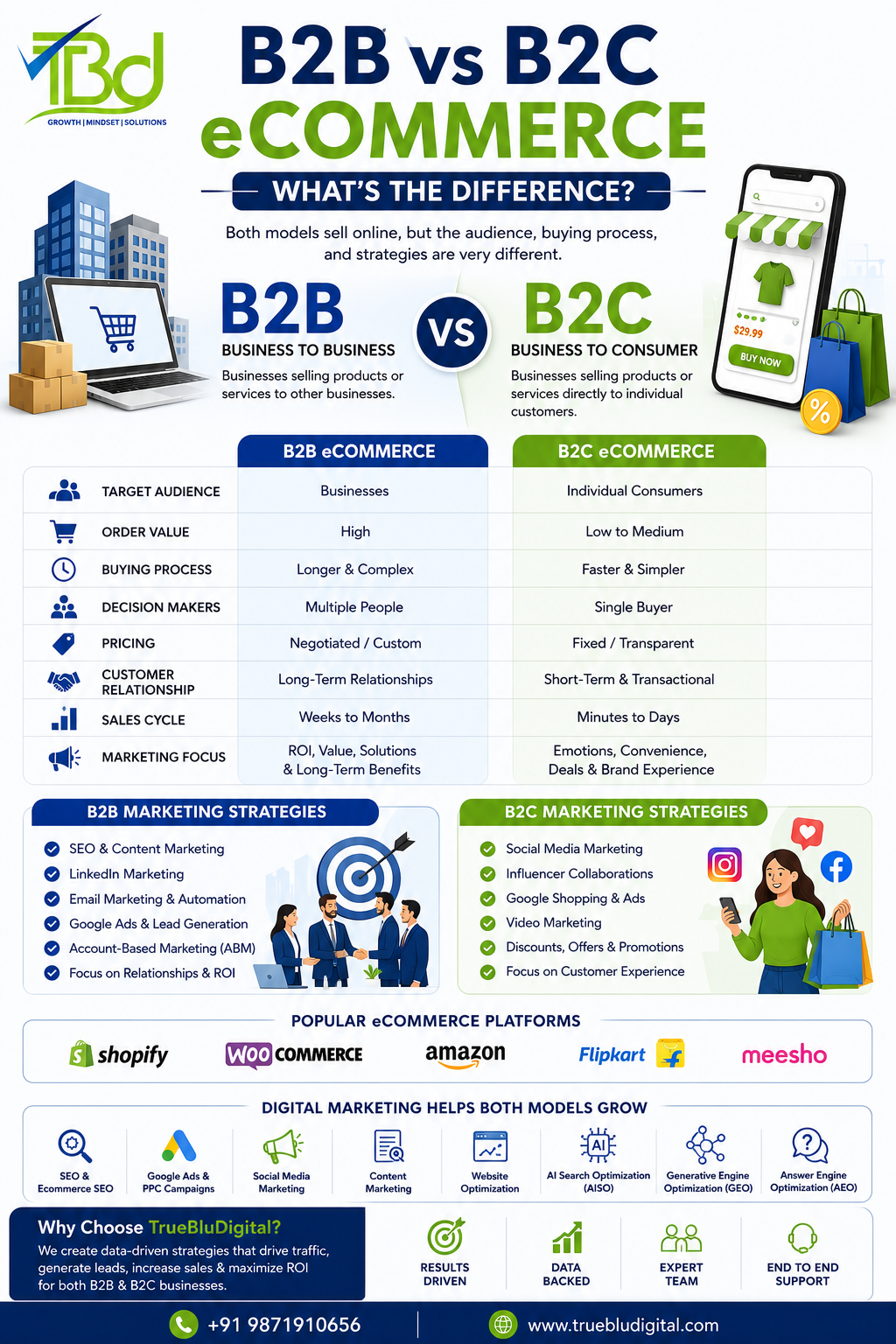
The eCommerce industry continues to grow rapidly in 2026, offering businesses new opportunities to sell products and services online. One of the first decisions entrepreneurs must make is whether to operate as a Business-to-Business (B2B) or Business-to-Consumer (B2C) eCommerce business.
While both models use digital platforms to sell products, they differ significantly in customer type, purchasing behavior, pricing, marketing, and sales strategy. Understanding these differences can help you choose the right business model and develop an effective digital marketing strategy.
What is B2B eCommerce?
B2B (Business-to-Business) eCommerce refers to online transactions between one business and another. Instead of selling directly to individual consumers, B2B companies sell products or services to wholesalers, retailers, manufacturers, distributors, or other organizations.
Examples of B2B Businesses
- Wholesale suppliers
- Industrial equipment manufacturers
- Software providers (SaaS)
- Office supply companies
- Business consulting services
B2B purchases often involve larger order values, negotiated pricing, and long-term business relationships.
What is B2C eCommerce?
B2C (Business-to-Consumer) eCommerce involves businesses selling products or services directly to individual customers through online stores or marketplaces.
Consumers typically make purchases based on convenience, pricing, product quality, reviews, and brand reputation.
Examples of B2C Businesses
- Fashion stores
- Electronics retailers
- Beauty brands
- Grocery delivery services
- Home décor stores
Popular platforms include Shopify, WooCommerce, Amazon, Flipkart, and Meesho.
Key Differences Between B2B and B2C eCommerce
| Feature | B2B eCommerce | B2C eCommerce |
|---|---|---|
| Target Audience | Businesses | Individual Consumers |
| Order Value | High | Low to Medium |
| Buying Process | Longer | Faster |
| Decision Makers | Multiple | Single Buyer |
| Pricing | Negotiated | Fixed |
| Customer Relationship | Long-Term | Transactional |
| Sales Cycle | Weeks or Months | Minutes or Days |
| Marketing Focus | ROI & Solutions | Emotions & Convenience |
Marketing Strategies for B2B eCommerce
B2B businesses focus on educating decision-makers and building trust.
Effective strategies include:
- Search Engine Optimization (SEO)
- Content Marketing
- LinkedIn Marketing
- Email Marketing
- Google Ads
- Lead Generation Campaigns
- Marketing Automation
- Account-Based Marketing (ABM)
The goal is to generate qualified leads and nurture long-term business relationships.
Marketing Strategies for B2C eCommerce
B2C businesses focus on attracting consumers and encouraging quick purchase decisions.
Popular strategies include:
- Social Media Marketing
- Influencer Marketing
- Google Shopping Ads
- Facebook & Instagram Ads
- Video Marketing
- Email Campaigns
- Loyalty Programs
- Seasonal Promotions
The emphasis is on creating engaging customer experiences that drive sales.
Which eCommerce Platform is Best?
Both B2B and B2C businesses can leverage powerful eCommerce platforms, including:
- Shopify
- WooCommerce
- Amazon
- Flipkart
- Meesho
The best platform depends on your products, target audience, and business goals.
How Digital Marketing Supports Both Models
Whether you operate a B2B or B2C business, digital marketing is essential for driving traffic, generating leads, and increasing sales.
Key Services Include
- Search Engine Optimization (SEO)
- Ecommerce SEO
- Google Ads & PPC Campaigns
- Social Media Marketing
- Content Marketing
- Email Marketing
- Website Optimization
- Conversion Rate Optimization (CRO)
- Lead Generation Campaigns
- AI Search Optimization (AISO)
- Generative Engine Optimization (GEO)
- Answer Engine Optimization (AEO)
These strategies help businesses improve online visibility, attract qualified customers, and maximize return on investment (ROI).
Why Choose TrueBluDigital?
At TrueBluDigital, we help both B2B and B2C businesses grow with data-driven digital marketing solutions. Our team creates customized strategies that increase website traffic, generate quality leads, improve conversions, and boost revenue.
Our services include:
- SEO Services
- Ecommerce SEO
- Google Ads Management
- Performance Marketing
- Social Media Marketing
- Website Optimization
- Google Business Profile Optimization
- AI Search Optimization (AISO)
- Generative Engine Optimization (GEO)
- Answer Engine Optimization (AEO)
- Content Marketing
- Lead Generation Campaigns
Whether you’re targeting businesses or consumers, we help you build a scalable online presence and achieve sustainable growth.
Conclusion
Both B2B and B2C eCommerce offer tremendous growth opportunities in 2026, but they require different approaches to sales, marketing, and customer engagement. B2B focuses on long-term relationships, higher-value transactions, and detailed decision-making, while B2C emphasizes convenience, brand experience, and faster purchasing decisions.
Choosing the right business model depends on your products, audience, and goals. With the right eCommerce platform and a strong digital marketing strategy, businesses can successfully grow online. Partnering with TrueBluDigital ensures you have the expertise and tools needed to drive traffic, increase conversions, and achieve long-term success.